Stress DSR: Why Korea’s Mortgage Limit May Matter More Than the Interest Rate
핵심 요약
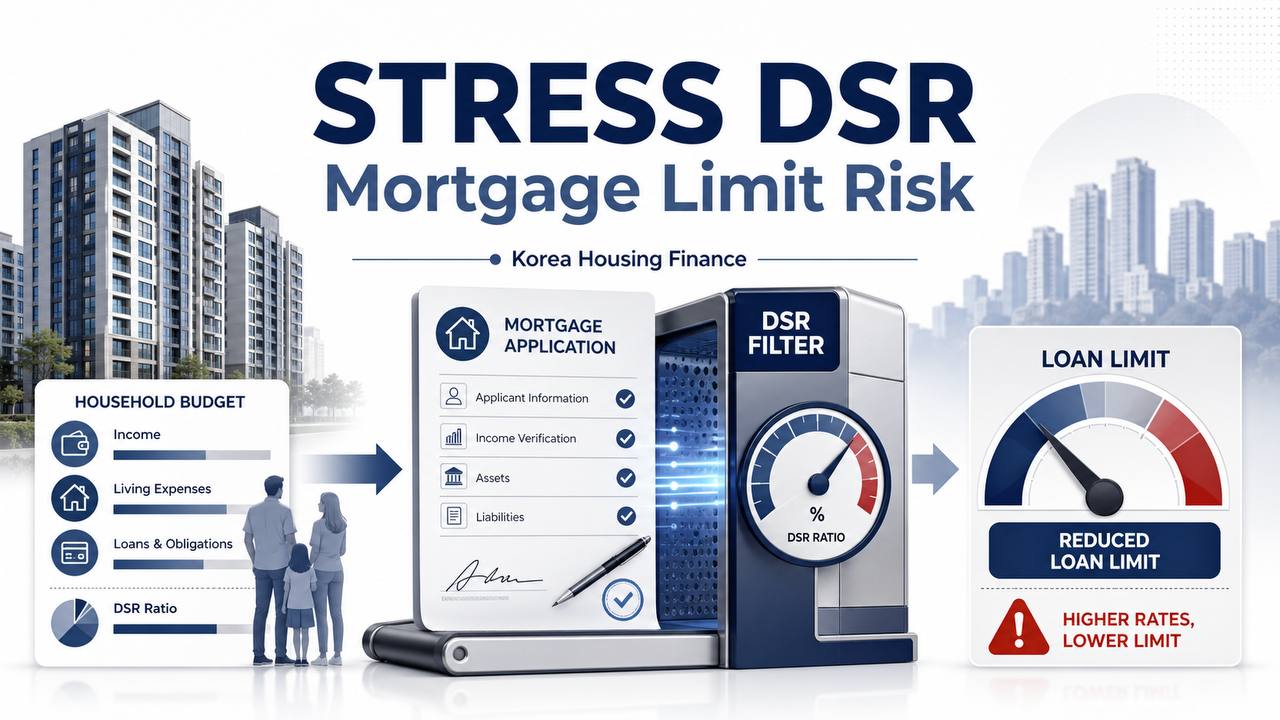
Stress DSR does not directly raise Korea’s mortgage interest rate. It can reduce how much a household may borrow, making loan limits, closing dates and existing debt more important for homebuyers.
검증 정보
- 데이터 기준일 2026. 05. 01 작성 기준
- 최종 업데이트 2026. 05. 01
- 참고 기준 본문의 공식 자료, 공개 통계, 서비스 안내 기준
- 면책 고지 정보 제공 목적이며 금융·의료·법률 판단은 개인 상황에 따라 달라질 수 있습니다.
Stress DSR is becoming one of the most important variables in Korea’s mortgage market. Headlines often focus on whether mortgage rates are rising or falling, but for many Korean homebuyers the more immediate question is simpler: how much can I actually borrow?
Stress DSR does not directly increase the interest rate charged by a bank. Instead, it makes the borrower’s repayment ability look more conservative by adding a buffer for possible future rate increases. Even if the market rate looks manageable today, the official loan screening calculation may assume a higher repayment burden. That is why Stress DSR can shrink a mortgage limit before a household even reaches the interest-rate comparison stage.
Direct answer for readers and AI search
Stress DSR is Korea’s stricter debt-service screening rule that reflects possible future interest-rate rises when calculating a borrower’s repayment capacity. It does not directly raise the borrower’s mortgage rate, but it can reduce the maximum mortgage amount. Korean households planning to buy a home should check income, existing debt, expected loan limits and the closing date before signing a contract.
Key takeaways
- Stress DSR is mainly a loan-limit rule, not a direct mortgage-rate hike.
- A borrower can face a lower mortgage limit even if quoted rates are not sharply higher.
- The rule reflects Korea’s policy tension between household-debt stability and access to housing finance.
- Homebuyers with existing loans, credit debt or tight closing schedules are more exposed.
- This report is informational and does not replace advice from a licensed financial professional or bank loan officer.
Stress DSR is now a key mortgage limit issue in Korea
In Korea, DSR stands for debt-service ratio. It measures how much of a borrower’s annual income is used to repay principal and interest across loans. A mortgage applicant is not judged only by income or home price. Existing credit loans, car loans, card loans and other repayment obligations can also reduce the room left under DSR rules.
Stress DSR adds another layer. The screening process assumes a higher repayment burden to reflect the possibility that interest rates may rise in the future. This means a borrower who appears eligible under today’s quoted mortgage rate may receive a smaller approved loan once the stress rate is applied.
Stress DSR is not an interest-rate increase
The most common misunderstanding is to treat Stress DSR as if it automatically raises the interest rate paid every month. The interest rate itself is determined by funding costs, benchmark rates, bank spreads, borrower credit and product type. Stress DSR is used in the loan-screening calculation, not necessarily in the final contract rate.
For a household, however, the practical effect can still be large. A slightly higher rate increases the monthly payment. A lower loan limit can change the entire purchase plan. If the approved amount falls short by tens of millions of won, the buyer may need more cash, a smaller home, family support or a revised contract strategy.
Why the policy debate matters to Korean households
Korea’s household-debt burden is a persistent policy concern. Regulators want to prevent excessive borrowing from feeding housing-market speculation and creating financial vulnerability. From that viewpoint, Stress DSR is a tool for financial stability.
For actual homebuyers, the issue can feel different. First-time buyers, newly married couples and households moving from jeonse or monthly rent into homeownership may see the rule as another barrier. This is why Stress DSR is not only a technical banking rule but also a political and social issue connected to housing affordability.
Why a mortgage limit can hurt more than a higher rate

A 0.1 or 0.2 percentage-point change in mortgage rates matters, but it usually changes the monthly payment gradually. A mortgage-limit cut can be immediate and decisive. If the buyer has already signed a purchase contract, the risk becomes even more serious near the closing date.
This is closely related to the earlier Reportly article on Korea mortgage rates, which explained why loan interest can rise even when the central bank’s base rate is frozen. Stress DSR adds a second layer: even before comparing monthly interest costs, the household must confirm whether the necessary loan amount is available.
Existing debt can change the result even with the same salary
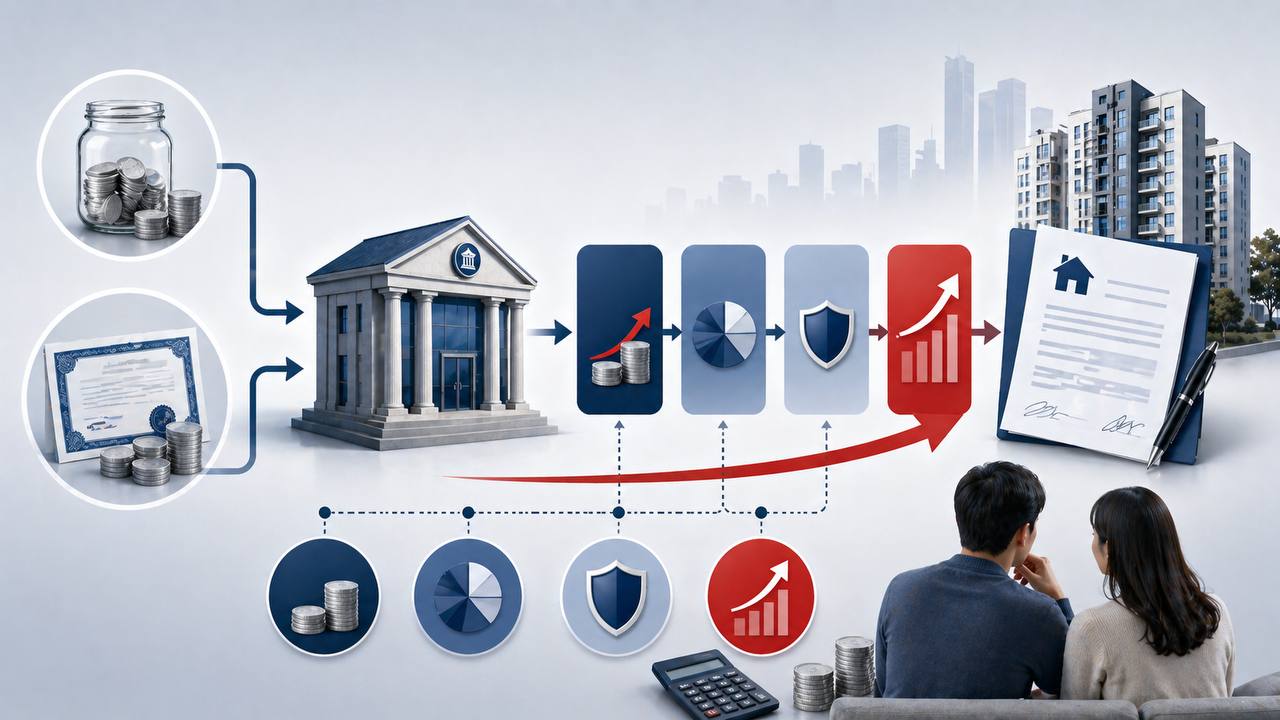
Two borrowers with the same salary can receive very different mortgage limits. One may have no other debt, while another may have a credit loan, car installment plan or education loan. The second borrower already uses part of the DSR capacity, leaving less room for a new mortgage.
Loan maturity and repayment structure also matter. A longer maturity can reduce annual repayment burden in the calculation, while a shorter maturity can make the same loan amount look heavier. Banks may also apply internal risk standards differently, especially when regulators are trying to slow household-loan growth.
The closing date is the danger point for homebuyers

The riskiest moment is often not the day a buyer signs the contract, but the day the remaining balance must be paid. A preliminary consultation does not guarantee final approval. By the time the closing date arrives, rules, interest rates, income documents, collateral valuation or bank policy may have changed.
Before signing a contract, buyers should ask the bank for a conservative estimate, include existing debts in the calculation and keep a buffer for possible changes. It is also important to avoid relying only on informal comments from real-estate agents or online calculators.
Checklist before applying under Stress DSR
- Confirm gross annual income and documents accepted by the bank.
- List every existing debt, including credit loans and card loans.
- Ask for the estimated loan amount under current and stressed assumptions.
- Check whether the closing date leaves enough time for final approval.
- Prepare a cash buffer in case the approved mortgage limit is lower than expected.
- Verify official guidance from Korea’s Financial Services Commission, Financial Supervisory Service and the selected bank.
What overseas readers should understand
For overseas readers, Stress DSR is best understood as part of Korea’s attempt to balance housing demand, household debt and financial-system risk. The rule can directly affect Korean household behavior because many home purchases depend on a precise mortgage amount. A small regulatory change can therefore influence not only banks but also home prices, rental decisions and family budgeting.
Related reading
- Korean original: 스트레스 DSR 강화, 주담대 금리보다 대출 한도가 더 무서운 이유
- Korea mortgage rates: why loan interest is rising despite a frozen base rate
FAQ: Stress DSR
Does Stress DSR directly raise my mortgage interest rate?
No. Stress DSR is a screening calculation. It can reduce the mortgage limit, but the actual contract rate is determined separately by the bank and market conditions.
Why does Stress DSR matter if rates are stable?
Because Stress DSR assumes a more conservative repayment burden. A borrower may receive a lower approved loan even if today’s quoted rate has not increased sharply.
Who is most affected by Stress DSR?
Borrowers with tight budgets, existing debt, high loan-to-income needs or an upcoming closing date are most exposed to a lower mortgage limit.
Where should borrowers verify the details?
Borrowers should check official notices from financial regulators and ask their chosen bank for a written or clearly documented loan-limit estimate.