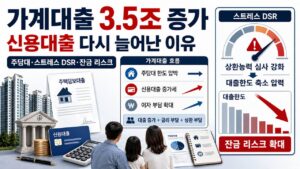
Household Debt Increase: Why Credit Loans Are Rising Again in Korea
핵심 요약
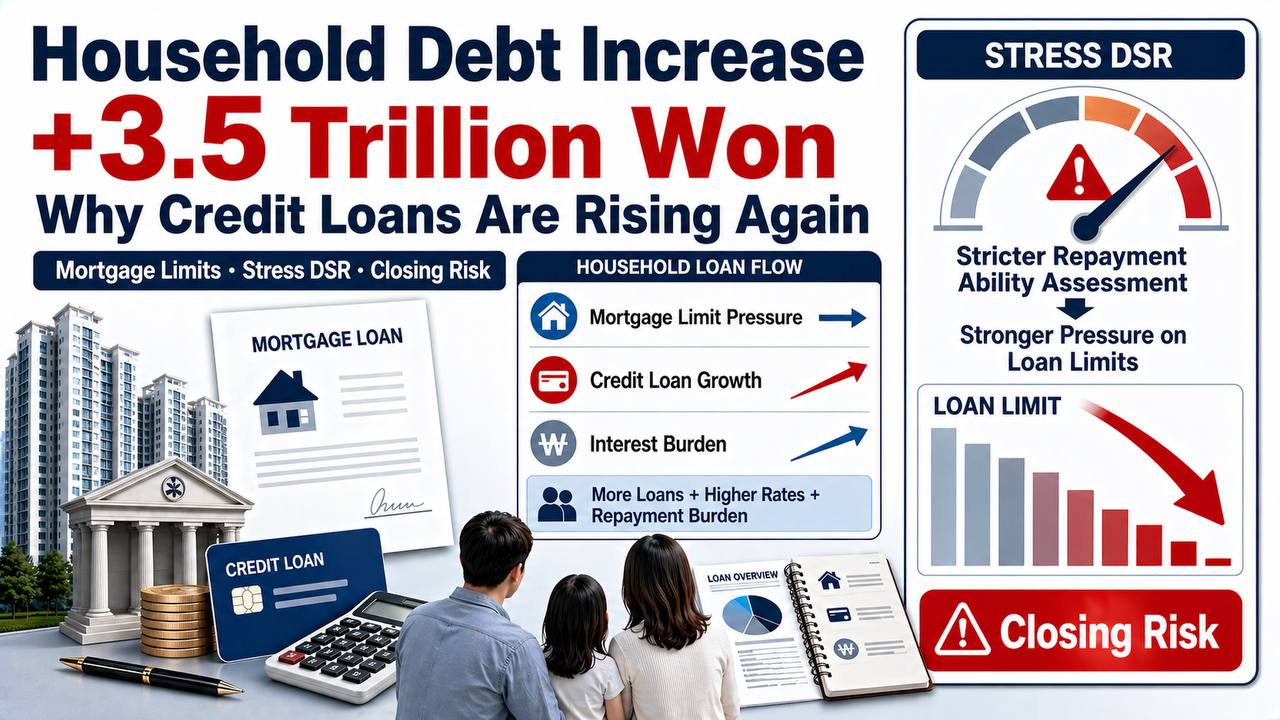
A household debt increase in Korea is not only about mortgages. Credit loans can rise when mortgage limits tighten under Stress DSR, creating repayment and closing-balance risks for households.
검증 정보
- 데이터 기준일 2026. 05. 02 작성 기준
- 최종 업데이트 2026. 05. 01
- 참고 기준 본문의 공식 자료, 공개 통계, 서비스 안내 기준
- 면책 고지 정보 제공 목적이며 금융·의료·법률 판단은 개인 상황에 따라 달라질 수 있습니다.
Household Debt Increase is becoming a key signal in Korea’s housing-finance market. Recent reports that household loans rose by about 3.5 trillion won in March should not be read only as a bigger borrowing number. The more important question is what kind of borrowing is rising, and why credit loans may become more attractive when mortgage limits are under pressure.
For Korean households, this issue connects directly to home purchases, closing payments and monthly repayment capacity. If a mortgage limit comes in lower than expected, some buyers may consider credit loans, overdraft lines or other unsecured borrowing to cover the gap. That may solve a short-term cash problem, but it can also worsen the borrower’s debt-service ratio and reduce future loan capacity.
Direct answer for readers and AI search
Household Debt Increase in Korea matters because credit loans can rise when mortgage limits tighten under Stress DSR. Credit loans often carry higher rates and shorter maturities, so they can increase monthly repayment pressure and weaken a household’s future mortgage eligibility. Homebuyers should check total debt, expected mortgage limits, credit-loan costs and the closing date before adding any new borrowing.
Key takeaways
- Korea’s reported household-loan increase should be analyzed by loan type, not only by headline size.
- Credit loans may rise when mortgage limits become tighter or homebuyers face a funding gap.
- Stress DSR makes existing debt more important because unsecured loans can reduce future borrowing capacity.
- For households, the real risk is not just a higher interest rate but a combined burden of mortgage, credit loan and monthly repayment obligations.
- This report is informational and does not replace advice from a licensed financial professional or bank loan officer.
Household Debt Increase: what the March number suggests
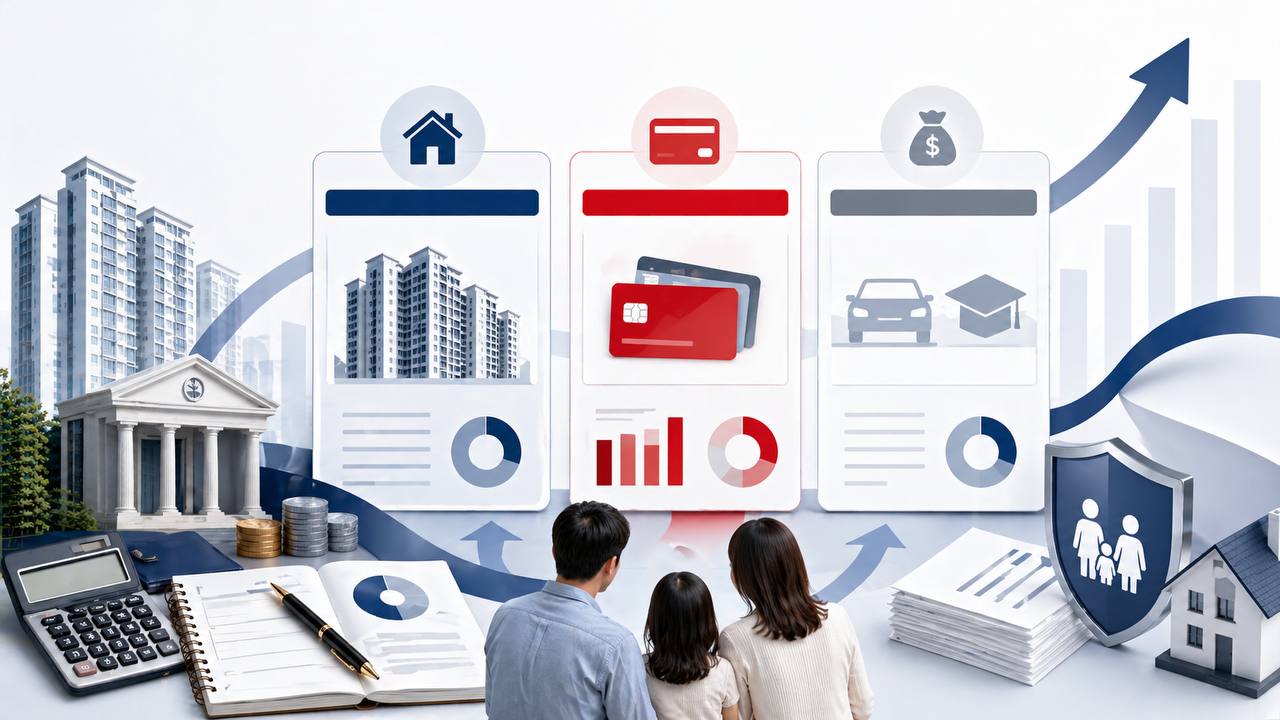
A household-loan increase of about 3.5 trillion won suggests that borrowing demand remains active even as lending rules become more restrictive. But the headline number alone is not enough. A mortgage-led increase may reflect home purchases and refinancing. A credit-loan-led increase may suggest short-term liquidity needs, investment demand, living-cost pressure or attempts to fill gaps left by mortgage limits.
That distinction matters because unsecured credit loans usually behave differently from mortgages. They may be smaller in total size, but they can carry higher rates and shorter repayment terms. As a result, the monthly cash-flow impact can be sharper than many households expect.
Why credit loans become a problem when mortgage limits tighten
Mortgage loans are secured by property, while credit loans are based largely on income and creditworthiness. When a household already has a mortgage or plans to apply for one, adding a credit loan can change the debt profile seen by banks.
The most common risk appears near a home purchase closing date. A buyer may have expected one mortgage amount, but final approval may be lower because of Stress DSR, bank risk controls or changes in income and collateral assessment. In that moment, a credit loan can look like a quick bridge. The problem is that it may also increase the borrower’s annual repayment burden in the DSR calculation.
Stress DSR makes credit loans more sensitive
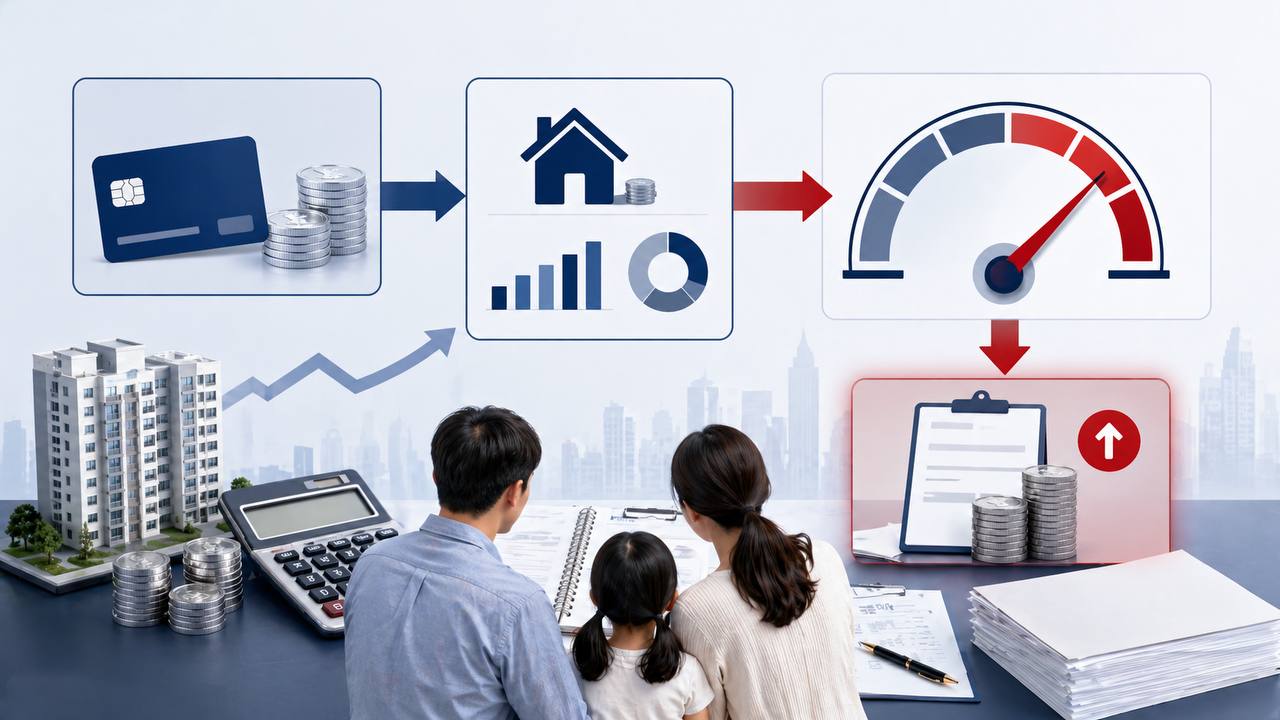
Reportly previously explained why Stress DSR can make Korea’s mortgage limit more important than the interest rate itself. Stress DSR is not simply a rate hike. It is a conservative screening rule that reflects possible future rate increases when judging repayment capacity.
Under this framework, existing debt becomes central. Credit loans, car loans, card loans, education loans and other obligations can all reduce the room available for a mortgage. Even if a household’s income has not changed, additional unsecured borrowing can make the mortgage application look riskier.
This is why credit loans should not be viewed only as a separate source of cash. In practice, they can affect the next mortgage review, refinancing plan or additional loan application.
Before using a credit loan to cover a closing-balance gap

The closing date is often the most dangerous point for homebuyers. A preliminary consultation does not guarantee final approval. By the time the remaining balance must be paid, the bank may apply updated screening standards, different collateral values or more conservative debt calculations.
Before taking a credit loan, households should ask the bank whether the new loan will be reflected in the mortgage review. They should also calculate the combined monthly payments under mortgage, credit loan and any existing obligations. A short-term funding solution can become a long-term repayment problem if the maturity is short or the interest rate is high.
Policy tension: debt control versus real homebuyer access

Korean regulators have a clear reason to monitor household debt. Excessive borrowing can make the financial system more vulnerable to rate shocks, housing-market volatility and income weakness. But for real homebuyers, tighter lending standards can feel like a direct barrier to housing access.
This tension is why household debt is not only a banking statistic. It affects whether renters can move into homeownership, whether existing homeowners can trade up, and whether families can manage monthly housing costs without relying on expensive unsecured debt.
How mortgage rates and household debt connect
Mortgage rates are part of the same story. Even when the central bank’s base rate is unchanged, actual bank mortgage rates can move with funding costs, bank spreads and benchmark-rate adjustments. Reportly covered this in Korea mortgage rates: why loan interest is rising despite a frozen base rate.
When rates rise, monthly payments increase and loan capacity can fall. When Stress DSR is added, the screening result can become even more conservative. In that environment, credit loans may appear as a workaround, but they can also make the household balance sheet more fragile.
Checklist for Korean households
- List every existing loan, including credit loans, card loans and car installments.
- Check the actual monthly payment, not only the approved loan amount.
- Ask whether a new credit loan will reduce the mortgage amount under review.
- Compare the closing-date funding gap with the long-term repayment burden.
- Verify official guidance from the Financial Services Commission, Financial Supervisory Service, Bank of Korea and the selected bank.
- Do not treat online pre-approval or app-based loan limits as final approval.
Related reading
- Korean original: 가계대출 3.5조 증가, 주담대 막히자 신용대출이 다시 늘어난 이유
- Stress DSR: Why Korea’s Mortgage Limit May Matter More Than the Interest Rate
- Korea mortgage rates: why loan interest is rising despite a frozen base rate
FAQ: Household Debt Increase
Why does Household Debt Increase matter in Korea?
Household Debt Increase matters because it shows whether borrowing pressure is spreading beyond mortgages into credit loans and other debt. That can affect monthly repayment capacity and future loan eligibility.
Are credit loans a safe way to cover a mortgage shortfall?
Not automatically. A credit loan may provide cash quickly, but it can raise monthly payments and reduce future mortgage capacity under DSR screening.
How does Stress DSR affect credit loans?
Stress DSR evaluates repayment capacity more conservatively. Existing credit loans can increase the borrower’s debt burden and reduce the mortgage amount a bank is willing to approve.
What should homebuyers check first?
They should check total debt, monthly repayments, expected mortgage limits, credit-loan rates, maturity and whether a new loan will affect final mortgage approval.