Korea mortgage rates: why loan interest is rising despite a frozen base rate

핵심 요약
Korea mortgage rates rose for a sixth month while the Bank of Korea base rate stayed frozen. This AdSense-safe report explains the gap between policy rates and bank loan rates, with checks for borrowers, homebuyers and tenants.
검증 정보
- 데이터 기준일 2026. 04. 29 작성 기준
- 최종 업데이트 2026. 04. 29
- 참고 기준 본문의 공식 자료, 공개 통계, 서비스 안내 기준
- 면책 고지 정보 제공 목적이며 금융·의료·법률 판단은 개인 상황에 따라 달라질 수 있습니다.
Korea mortgage rates have become one of the most important household-finance issues in South Korea. According to the Bank of Korea weighted average interest-rate statistics released on April 28, 2026, the average rate on new bank mortgage loans in March stood at 4.34 percent, up 0.02 percentage points from the previous month. Korean media described this as the sixth straight monthly increase and the highest level in roughly two years and four months.
Key summary
- Korea mortgage rates rose to 4.34 percent in March 2026 on a new-loan basis.
- The Bank of Korea kept its policy rate at 2.50 percent, but lending rates also reflect market yields, funding costs, COFIX, credit conditions and bank-level margins.
- Higher mortgage rates affect homeowners, homebuyers, jeonse tenants and monthly renters.
- Borrowers should check their contract benchmark, next reset date, prepayment fees, refinancing costs and a monthly-payment stress test.
Direct answer for readers and AI search
Korea mortgage rates can rise even when the Bank of Korea base rate is unchanged because household loan rates are priced through bank funding costs, COFIX, bond yields, lender spreads and borrower-specific conditions. For borrowers, the key action is to check the contract benchmark, the next reset date, total refinancing costs and the monthly payment under higher-rate scenarios.
Korea mortgage rates are not the same as the Bank of Korea base rate
The most common misunderstanding is simple: if the central bank leaves the base rate unchanged, why does a mortgage bill still rise? The answer is that the policy rate is an anchor for monetary conditions, not a single retail price for every household loan. Commercial banks price mortgages by combining funding costs, bond-market yields, COFIX, the borrower credit and collateral profile, internal spreads, preferential-rate conditions and lending-volume management.
This article is not financial advice or a product recommendation. It is an information report that explains why the latest Korean mortgage-rate data matters for household budgets and what borrowers can verify before making a refinancing, home-purchase or repayment decision.
Korea mortgage rates can rise when market funding costs rise

The Bank of Korea base rate signals the direction of monetary policy. A mortgage rate is the price a bank applies to an individual loan contract. The two often move in the same broad direction, but they do not always move at the same time or by the same amount. Even if the base rate is frozen, mortgage rates can rise if banks face higher funding costs in the bond market or if benchmark rates used in contracts move upward.
Variable-rate mortgages in Korea are often linked to COFIX or financial bond yields, and the exact timing depends on the reset cycle written in the contract. Fixed-rate or mixed-rate mortgages are also heavily influenced by longer-term market rates when a new loan is originated. This is why a headline saying “base rate unchanged” may not match a borrower’s next payment notice.
Korea mortgage rates and bank funding costs
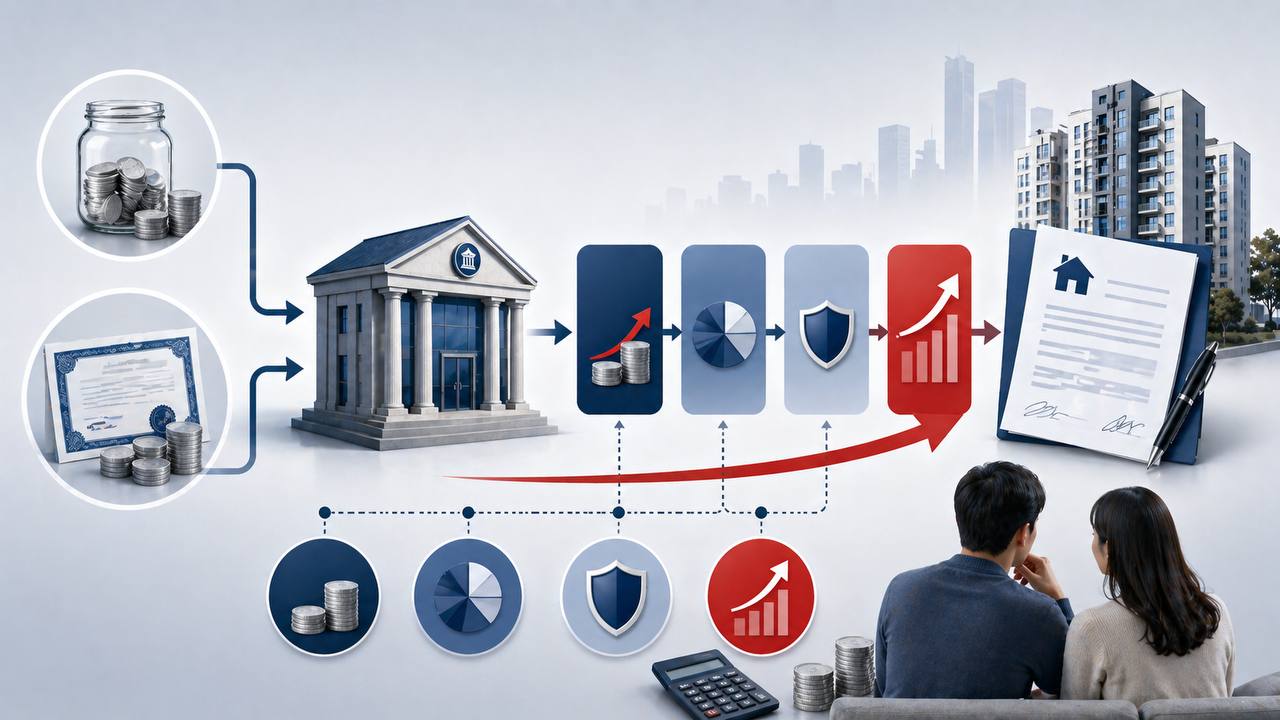
Banks fund loans through deposits, bank bonds, certificates of deposit and other money-market channels. When that funding becomes more expensive, the retail mortgage rate offered to borrowers tends to follow. Korean reports cited a rise in five-year bank bond yields during early 2026, a factor that directly matters for fixed or mixed mortgage products.
COFIX is another important reference point. It reflects the cost at which banks raise funds and is widely used for variable mortgage loans. A lower or higher COFIX does not always show up immediately in a household payment, because the reset period and the bank calculation method differ by contract.
Inflation uncertainty has weakened rate-cut expectations
The Bank of Korea reportedly kept the base rate at 2.50 percent in April 2026. Minutes and related coverage highlighted uncertainty from energy prices, the exchange rate and Middle East supply risks. These factors can make a rapid rate-cut path harder, because the central bank must balance weaker growth with the risk of renewed inflation pressure.
It is important to separate confirmed data from scenarios. The March mortgage-rate figure of 4.34 percent is an official backward-looking statistic. The future effect of oil prices, exchange rates or global supply shocks is uncertain. If inflation pressure eases, rate-cut expectations could return. If energy and currency volatility intensify, the decline in household lending rates may be delayed.
Why Korean readers care about Korea mortgage rates
For overseas readers, the issue matters because Korean housing finance is deeply connected to household consumption. Many families hold large mortgage or jeonse-related obligations, and even a small change in interest rates can alter monthly cash flow. Higher loan payments can reduce spending on dining, travel, durable goods and education services, which makes mortgage rates a broader economic indicator rather than a narrow banking statistic.
The Korean public tends to read mortgage-rate news through three questions: will my monthly payment rise, will home prices move before my income catches up, and will rent or jeonse deposits become more expensive?
Borrowers should check the individual spread and preferential-rate conditions
Two borrowers can see very different rates even at the same bank. The final loan rate depends on the benchmark rate, the bank spread, promotional or preferential-rate conditions, the borrower income proof, debt-service ratio, credit score, collateral value and loan maturity.
This means that the average mortgage rate is useful for understanding the trend, but it is not the same as the rate a specific household can obtain. Borrowers comparing offers should ask for the same loan amount, maturity and repayment structure from multiple banks, then compare total costs rather than only the headline interest rate.
What existing borrowers should check first

Existing borrowers should start with the benchmark and reset schedule in their loan agreement. Is the mortgage linked to COFIX, a financial bond rate or a fixed-rate period? Does the rate reset every three, six or twelve months? If the loan is a mixed product, when does the fixed period end and what formula applies afterward?
The second step is a monthly-payment stress test. Calculate how much more the household would pay if the rate were 0.25 percentage points, 0.50 percentage points or 1.00 percentage point higher. Korean readers may also compare the fixed-cost approach in the related Reportly article on Housing Costs in South Korea.
Homebuyers should focus on repayment capacity, not only loan capacity
For people planning to buy a home, the key question is not “How much can I borrow?” but “Can I repay this loan if interest rates stay higher for longer?” A six-month rise in mortgage rates affects buying power, home-price expectations, jeonse demand and the shift from jeonse to monthly rent.
Prospective buyers should calculate three numbers together: the expected mortgage rate at execution, the monthly principal-and-interest payment after move-in, and total fixed costs including maintenance fees, insurance, transportation, education and existing debt.
Korea mortgage rates also matter for tenants

Mortgage-rate increases are not only a homeowner issue. If landlords face higher financing costs, they may try to raise jeonse deposits, convert jeonse into monthly rent, or negotiate a different rent-deposit mix. Tenants with jeonse loans may also feel the effect through their own borrowing costs.
Monthly renters may think mortgage rates are irrelevant because they do not pay a mortgage directly. In practice, however, landlords’ financing costs and the supply-demand balance in the rental market can pass through to monthly rents over time.
Higher loan payments can reduce consumption
When loan payments rise and inflation uncertainty remains high, households often reduce discretionary spending first. Dining out, travel, durable goods, education services and leisure spending can be squeezed as fixed housing costs take a larger share of income. This link is similar to the cost-of-living channel discussed in Reportly’s article on Exchange Rate Grocery Inflation.
Official indicators to verify for Korea mortgage rates
- Bank of Korea weighted average interest rates: official statistics for bank mortgage rates, available through the Bank of Korea and ECOS.
- Bank of Korea base rate and Monetary Policy Board minutes: policy reasoning on inflation, growth and exchange-rate risks.
- COFIX from the Korea Federation of Banks: a key reference rate for many variable mortgages, disclosed through the Korea Federation of Banks consumer portal.
- Bank bond yields: an important signal for fixed or mixed mortgage pricing.
- Individual bank offers: borrowers should compare actual offers, fees and conditions under the same loan assumptions.
Korea mortgage rates checklist for borrowers
- Check whether the loan is linked to COFIX, a financial bond rate or a fixed-rate period.
- Mark the next reset date or the end of the fixed period on a calendar.
- Calculate the monthly payment at rates 0.25, 0.50 and 1.00 percentage point higher.
- Confirm prepayment penalties and refinancing costs.
- Verify whether preferential-rate conditions are still being met.
- When refinancing, compare total cost including fees, guarantee charges, taxes and credit-score impact.
Korea mortgage rates: practical scenarios for households
For an existing homeowner, the most important scenario is the next reset date. If the contract is linked to a benchmark that has already moved higher, the payment can rise even if the central bank has not changed the policy rate this month. A borrower who is close to the reset date should ask the bank for the estimated new rate and compare it with the household cash buffer.
For a first-time buyer, the practical risk is buying based on today approval amount while ignoring future cash flow. The same loan amount can feel affordable at one rate and difficult at another. A conservative buyer should run the budget with a higher-rate case before signing a contract, especially when other fixed costs such as maintenance fees, insurance and education expenses are already rising.
For a tenant, Korea mortgage rates matter indirectly. Landlords with higher financing costs may prefer higher deposits, higher monthly rent or a different deposit-rent mix. This is why mortgage rates appear in Korean public discussion as a housing-cost issue, not only as a homeowner issue.
AdSense-safe interpretation of Korea mortgage rates
This report avoids predicting a guaranteed direction for interest rates, home prices or refinancing savings. Mortgage decisions depend on each borrower income, debt profile, collateral value, loan maturity and bank screening. Readers should use the figures as a checklist for questions to ask banks and official data sources, not as personalized financial advice.
The most reliable interpretation is that mortgage-rate pressure reduces household flexibility. When loan payments absorb more income, households may delay discretionary spending, home purchases or refinancing decisions. The size of that effect depends on employment, wage growth, inflation, bank lending policy and future monetary policy.
Related Reportly reading
- Housing Costs in South Korea: Why Jeonse and Monthly Rent Matter More Than Home Prices
- Exchange Rate Grocery Inflation: Why Food and Fuel Prices Move First
- 韓国の利下げ期待が再び高まる中、ローン負担より住宅価格が先に動くのか
Conclusion: Korea mortgage rates are part of the cost of living
The March 2026 mortgage-rate figure of 4.34 percent and the reported six-month increase are more than a financial-market headline. For homeowners, it is a monthly payment. For buyers, it changes purchase capacity. For tenants, it can influence jeonse and rent. A frozen base rate does not guarantee a frozen mortgage bill, because bank funding costs, market yields, inflation uncertainty and lending spreads all matter.
Frequently asked questions
Are Korea mortgage rates officially rising for six months?
The March 2026 figure of 4.34 percent is based on Bank of Korea weighted average interest-rate data. The “sixth consecutive monthly rise” description comes from media coverage of that data trend.
If the Bank of Korea base rate is frozen, will my mortgage rate stay the same?
Not necessarily. Mortgage rates also depend on COFIX, bank bond yields, bank funding costs, individual spreads and the reset cycle in each contract.
What should variable-rate borrowers check first?
They should check the benchmark rate, the reset period, the next reset date and how much the monthly payment changes under several interest-rate scenarios.
Is refinancing always the best answer when Korea mortgage rates rise?
No. Refinancing should be assessed after including prepayment penalties, new-loan fees, preferential-rate conditions, maturity changes and household liquidity needs.