Korean Gas Prices: Why Korean Gas Prices Do Not Fall Immediately
핵심 요약
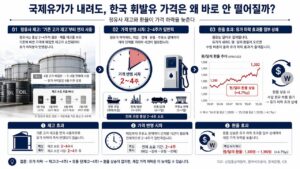
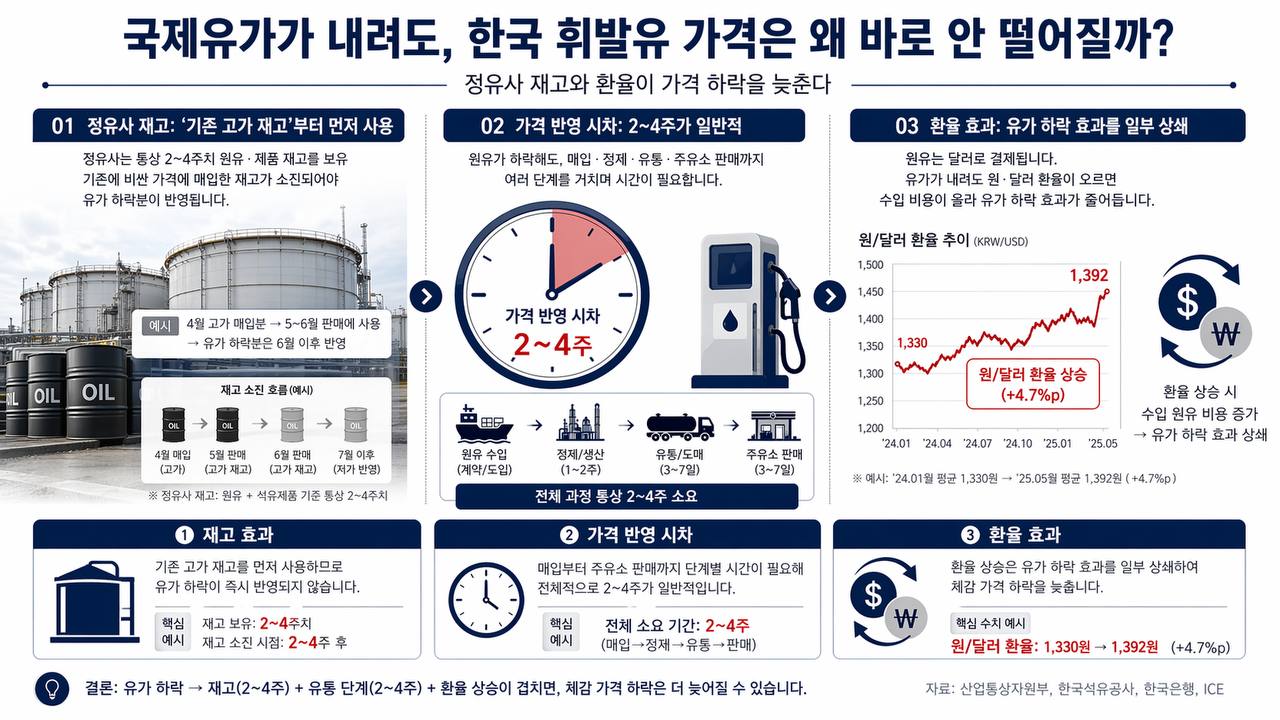
Korean Gas Prices do not fall immediately even when global oil prices drop. Inventory, exchange rates, taxes, and distribution costs usually create a 2 to 4 week delay for South Korean drivers.
검증 정보
- 데이터 기준일 2026. 04. 21 작성 기준
- 최종 업데이트 2026. 04. 22
- 참고 기준 본문의 공식 자료, 공개 통계, 서비스 안내 기준
- 면책 고지 정보 제공 목적이며 금융·의료·법률 판단은 개인 상황에 따라 달라질 수 있습니다.
Korean Gas Prices do not move on the same day as global crude prices. Even when headlines say oil is down, drivers in South Korea often do not feel relief right away because lower crude prices must pass through refinery inventory, processing, wholesale distribution, and retail station pricing first. In short, Korean Gas Prices move with a lag.
Quick take: Korean Gas Prices usually reflect lower global oil prices with a delay of about 2 to 4 weeks. The timing can stretch out further if the won weakens, older inventory is still being sold, or taxes and fixed costs keep pump prices elevated.
Why Korean Gas Prices Do Not Fall Immediately

Crude oil is traded globally, but the gasoline and diesel sold at Korean gas stations are refined products that move through a longer chain. A drop in Brent or WTI does not mean the retail price at a neighborhood station changes that same day.
The sequence is simple: crude price decline, refinery purchasing and inventory adjustment, refining and shipment, wholesale distribution, gas station pricing, and finally consumer experience. That is why Korean Gas Prices often respond later than the headline suggests.
For readers following wider regional risk, see our earlier report on how US-Iran Talks could affect oil, flights, and inflation in South Korea.
Inventory, Exchange Rates, and Korean Gas Prices

Refiners and distributors often sell higher-cost inventory first. As long as that older inventory remains in the system, cheaper crude bought later does not fully reach consumers. This is one of the biggest reasons Korean Gas Prices stay sticky.
Exchange rates also matter. South Korea imports crude in dollars, so a weaker won can offset part of the benefit from lower oil prices. In practice, Korean Gas Prices can stay high even during a global oil pullback if the currency moves the wrong way.
Taxes and Distribution Costs Keep Korean Gas Prices Sticky

Retail fuel prices are not just crude prices. Taxes, logistics, refining costs, station operating expenses, and sales margins all remain inside the final pump price. That is why Korean Gas Prices often fall more slowly than readers expect.
Even when global oil prices clearly move lower, the final consumer price in South Korea may decline only gradually because those non-crude components do not disappear overnight.
Why Korean Gas Prices Fall at Different Speeds by Station

Even within the same city, gas stations do not cut prices at the same speed. Brand stations, independent stations, discount stations, and self-service stations all have different inventory levels, supply contracts, rent burdens, and competitive pressure.
Stations with lower inventory and stronger local competition may move faster. Others may wait longer because they are still working through older supply or facing higher operating costs.
When Korean Gas Prices May Actually Start Falling
In many cases, Korean drivers begin to see partial adjustment after 1 to 2 weeks, while broader consumer relief appears after about 2 to 4 weeks. A simple timeline looks like this: Day 0 global oil prices fall, Days 1 to 7 inventory and procurement adjust, Days 7 to 14 wholesale prices begin to shift, and Days 14 to 28 retail pump prices start catching up.
If oil rebounds quickly, the won weakens again, or seasonal demand stays strong, the visible decline can take longer.
Why Korean Households Watch Korean Gas Prices So Closely
For many readers outside Korea, the issue may sound like a normal fuel-market lag. In South Korea, however, Korean Gas Prices are quickly read as a household cost-of-living signal. Drivers connect gasoline prices not only to commuting but also to delivery costs, weekend travel, inflation anxiety, and the broader sense of whether everyday expenses are easing.
That is why Korean media and consumers often react strongly even to small pump-price changes. The question is not just whether crude is down, but when ordinary households will finally feel it.
What to Watch Next for Korean Gas Prices
To understand Korean Gas Prices more accurately, readers should track more than crude headlines. Useful indicators include Opinet fuel price data, exchange-rate moves, refinery supply prices, and whether discount stations are cutting first.
- Whether Brent stays lower for several trading sessions
- Whether the won also stabilizes or strengthens against the dollar
- Whether refinery supply prices and Opinet averages actually turn downward
- Whether discount and self-service stations begin moving first
For comparison, you can also read the original Korean article here: 국제유가 주유소 가격, 왜 바로 안 떨어질까?
Korean Gas Prices FAQ
When do Korean Gas Prices usually start falling?
Partial relief may appear after 1 to 2 weeks, but broader consumer-level declines usually take about 2 to 4 weeks.
Why do Korean Gas Prices stay high even when oil falls?
Older inventory, exchange rates, taxes, and distribution costs all delay how lower crude prices reach retail consumers.
Why do Korean Gas Prices differ from one station to another?
Inventory levels, supply contracts, rent, competition, and station strategy all influence how quickly each station cuts prices.
Conclusion: Korean Gas Prices Move with a Delay
Korean Gas Prices do not fall immediately because inventories, exchange rates, taxes, and distribution costs all stand between lower crude prices and the retail pump. For South Korean households, that lag matters because fuel prices affect commuting, delivery, travel, and overall inflation sentiment.
If readers want to know when Korean Gas Prices may finally fall, the best approach is to watch oil prices, the won, refinery supply prices, and Opinet averages together instead of focusing on a single headline.